
$87.00 $599.00 Sale

Dr. Michael Shermer
Professor
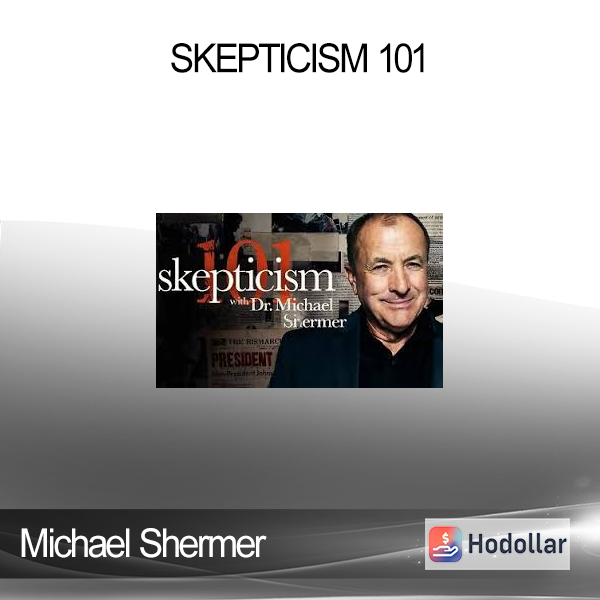
In Skepticism 101, a nine-hour course, Dr. Michael Shermer explores the foundations of critical thinking, scientific reasoning, and the nature of belief through an interdisciplinary lens.
He examines key concepts including truth, rationality, causation, and cognitive biases, while providing practical tools for evaluating claims and understanding human decision-making processes.
Through detailed analyses of conspiracy theories, religious beliefs, and philosophical questions about God’s existence, the course demonstrates how scientific skepticism can be applied to complex real-world issues.
The material concludes by bridging the gap between scientific methodology and human belief systems, offering frameworks for understanding both empirical truth and meaningful mythological narratives in modern society.
Lectures
Lesson 1: What Can We Know?
In the introductory lecture, Dr. Michael Shermer explores the nature of truth, distinguishing between subjective internal truths and objective external truths.
He examines the methods developed since the scientific revolution for determining provisional truths about the world.
The lecture addresses the challenges of navigating a so-called post-truth era and concludes by exploring the limits of human knowledge, including known unknowables such as consciousness, free will, God, and the ultimate reason for existence.
Lesson 2: The Methods of Science
In lecture two, we investigate the relationship between science and skepticism, focusing on how scientists approach claims using the null hypothesis as a starting point.
The lecture defines science as a set of methods designed to describe and interpret observed or inferred phenomena, emphasizing testability and evidence-based reasoning.
The discussion concludes with an examination of signal detection theory and its applications in medical diagnosis, public policy, and cost-benefit analysis.
Lesson 3: How We Make Decisions
In lecture three, Dr. Shermer explores rationality, irrationality, and free will, examining their roles in decision-making, self-control, and goal pursuit.
The discussion covers how the prefrontal cortex processes decisions, the tension between short-term gratification and long-term objectives, and strategies for rational self-control.
The lecture concludes by examining the relationship between happiness, meaningfulness, and rationality, emphasizing the role of values, identity, and purpose.
Lesson 4: Cause and Effect
In lecture four, we examine scientific thinking and causality, focusing on how science distinguishes correlation from causation through methods such as randomized controlled trials and natural experiments.
The lecture introduces Bayesian reasoning as a tool for updating beliefs based on evidence, with examples ranging from medical diagnosis to UFO sightings.
The discussion emphasizes maintaining an open yet skeptical mind while recognizing that most effects have multiple causes.
Lesson 5: Mistakes Our Brains Make
In lecture five, we explore cognitive biases and thinking errors that influence perception and decision-making, including anchoring, availability bias, and confirmation bias.
Dr. Shermer demonstrates these concepts through experiments and examples such as the Monty Hall problem and false memory phenomena.
The lecture concludes by examining how statistical misunderstandings and pattern recognition can lead to false correlations and beliefs in coincidences.
Lesson 6: Why We Believe Conspiracies
In lecture six, we explore conspiracy theories, examining their types, psychological appeal, and sociological roots.
The lecture outlines three forms of conspiracism and addresses cognitive biases, logical fallacies, and threat detection mechanisms.
Real historical conspiracies are compared with unfounded theories, emphasizing the importance of critical thinking and evidence-based analysis.
Lesson 7: Miracles, Myths, and Meaning
In lecture seven, Dr. Michael Shermer examines miracles, myths, and religion through a scientific and skeptical lens.
The lecture analyzes David Hume’s framework for evaluating miraculous claims and explores why religious miracle stories may function as meaningful mythological narratives rather than literal events.
The discussion highlights the psychological, social, and symbolic significance of myths as archetypal representations that convey values, meaning, and guidance.
Lesson 8: The Question of God
In the final lecture, we examine the question of God’s existence, exploring theism, atheism, agnosticism, and fideism, alongside philosophical arguments such as Aquinas’ five proofs.
The lecture investigates why people believe in God, considering genetics, neuroscience, parental influence, and cultural context.
It concludes with Shermer’s God Gambit, proposing that sufficiently advanced technology may be indistinguishable from divine power, emphasizing the need to understand belief through scientific, experiential, and pragmatic lenses.
– After making a purchase, you will see a View your order link to the Downloads page. Here you can download all the files related to your order.
– In case the link is broken for any reason, please contact us and we will resend a new download link.
– If you can’t find the download link, please don’t worry about it. This course is usually available and shipped within one day
– The course you purchased will have lifetime access
– Our support staff is the best by far! Please contact us at email: [email protected] and we will be happy to help!