
$67.00 $399.00 Sale

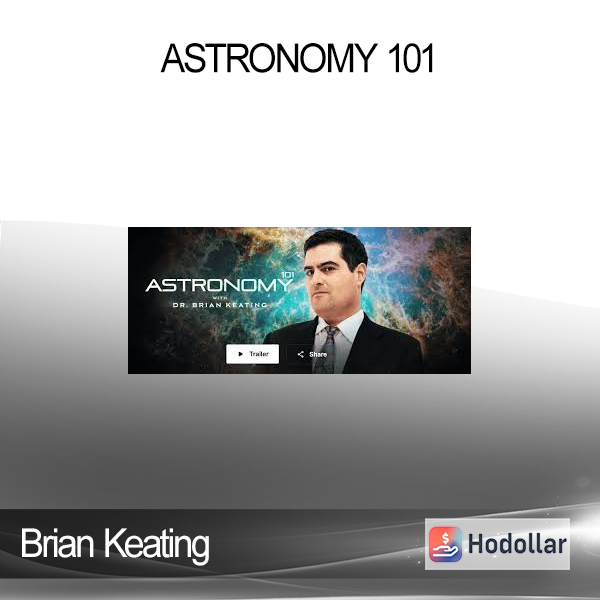
Dr. Brian Keating
Astrophysicist
In Astronomy 101, a seven-hour course, Dr. Brian Keating launches into a fascinating exploration of the history and principles of astronomy from ancient observations to cutting-edge discoveries.
We follow the evolution of astronomical tools and techniques, the cosmic distance ladder, and the properties and life cycles of stars and galaxies.
The course delves into the fundamental principles of gravity, the Big Bang theory, and the search for extraterrestrial life, while also highlighting the contributions of groundbreaking scientists and the profound impact of astronomy on our understanding of the universe and our place within it.
Show less
Study Group
Lectures
1. Looking Upward
In our introductory lecture, Dr. Brian Keating presents astronomy as humanity’s oldest science, tracing its evolution from ancient naked-eye observations to modern scientific inquiry.
He explores how early astronomers like Aristotle, Copernicus, and Galileo developed increasingly accurate models of the cosmos, while highlighting how even brilliant scientists made significant errors alongside their groundbreaking discoveries.
The lecture emphasizes astronomy’s unique accessibility as a science that anyone can practice with their own eyes, while also discussing its profound impact on human civilization through developments in timekeeping, navigation, and our understanding of our place in the universe.
2. The Astronomer’s Toolkit
In lecture two, we trace the evolution of astronomical observation tools from the human eye to modern telescopes and detectors, and explore how technological advances have deepened our understanding of the universe.
We examine the principles and development of refracting and reflecting telescopes, highlighting their strengths and limitations, and discuss the transformative role of spectroscopy in revealing the composition and motion of celestial bodies.
The lecture also touches on the progression of astronomical imaging, from early hand-drawn sketches to digital photography, showing how each breakthrough has expanded our ability to study the cosmos.
3. Measurements and Mysteries
In lecture three, we learn about the cosmic distance ladder, a series of methods astronomers use to measure distances in the universe.
Starting with measurements on Earth, we progress to the moon, sun, and planets using techniques like parallax and the inverse square law of light intensity.
The lecture discusses the properties of our solar system, including the sun, planets, and minor bodies like asteroids and dwarf planets.
We also delve into the field of exoplanets, discussing how they are detected using the Doppler shift and transit methods, and the potential for these techniques to reveal signs of life and even technology on distant worlds.
4. The Life of Stars
In lecture four, we delve into the properties and life cycle of stars, focusing on our sun as the primary example.
We explore the process of nuclear fusion, the composition of the solar system, and the methods used to determine the age of the Earth and the sun.
The lecture covers the evolution of stars, from their formation to their eventual fate.
We discuss the motion of stars and planets, governed by Newton’s laws of gravity, and introduce the Milky Way galaxy and its structure.
5. Galaxies and Gravity
In lecture five, we study the fundamental principles of gravity and orbital dynamics, and their application to understanding the Milky Way galaxy.
Dr. Keating covers Newton’s laws of motion and universal gravitation, explaining how these principles help measure celestial masses and distances.
The discussion highlights the role of globular clusters in revealing the presence of dark matter and challenging our understanding of the universe’s composition.
6. Distance and Dark Matter
In lecture six, we investigate the role of globular clusters and Cepheid variable stars in measuring cosmic distances, focusing on Henrietta Swan Leavitt’s period-luminosity relationship.
The discussion explores Edwin Hubble’s use of Cepheid variables to prove the existence of galaxies beyond the Milky Way.
We examine evidence for dark matter through galactic rotation curves and gravitational effects, and discuss theories about its nature and detection, including gravitational lensing.
7. Beginning to End
In lecture seven, we explore the Big Bang theory, the expansion of the universe, and implications for the past and future of the cosmos.
We examine Olbers’ Paradox, Hubble’s law, and the relationship between distance, redshift, and the age of the universe.
The lecture concludes with the ultimate fate of the universe, from the formation of the first galaxies to the dissipation of black holes through Hawking radiation, and the possibility of the universe respawning into another universe.
8. Beyond Earth
In our eighth and final lecture, we turn to comets, meteors, and the search for extraterrestrial life.
We examine how these bodies may have contributed to Earth’s water and the origin of life, and study meteorites as records of the early solar system.
The lecture explores alien civilizations, the Fermi Paradox, and efforts to detect intelligent life.
Dr. Keating concludes by exploring the relationship between science and poetry, and how scientific understanding deepens our appreciation of the cosmos.
– After making a purchase, you will see a View your order link to the Downloads page. Here you can download all the files related to your order.
– In case the link is broken for any reason, please contact us and we will resend a new download link.
– If you can’t find the download link, please don’t worry about it. This course is usually available and shipped within one day
– The course you purchased will have lifetime access
– Our support staff is the best by far! Please contact us at email: [email protected] and we will be happy to help!