
$79.00 $499.00 Sale

Dr. Stephen R. C. Hicks
Philosopher
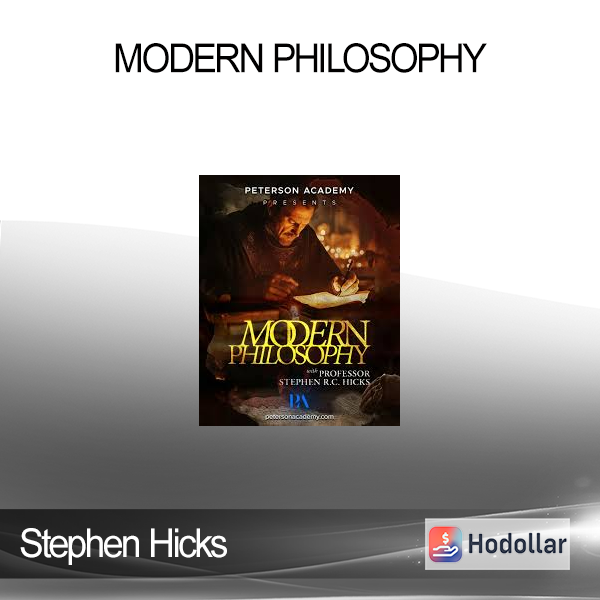
In Modern Philosophy, a nine-hour course, we explore the development of modern philosophy from the 17th to the 19th century. We examine the pivotal roles of thinkers such as Francis Bacon, René Descartes, John Locke, Voltaire, Jean-Jacques Rousseau, David Hume, Immanuel Kant, Georg Hegel, Karl Marx, John Stuart Mill, and Friedrich Nietzsche. The course highlights the contrasting approaches of empiricism and rationalism, the Enlightenment’s emphasis on reason and individual liberty, and the Counter-Enlightenment’s critiques of these principles, culminating in the ongoing influence of these ideas in the 19th century.
Study Group
Lectures
LessonLocked
1. Birth of the Modern
In our first lecture, Dr. Hicks introduces us to modern philosophy, focusing on the pivotal role played by Francis Bacon in the early 17th century. We explore Bacon’s groundbreaking work, The Great Instauration, particularly the Novum Organum, which proposes a new empirical and experimental approach to acquiring knowledge, emphasizing the importance of inductive reasoning, the careful observation of nature, and the need for a critical examination of the human mind’s inherent biases and limitations.
LessonLocked
2. Radical Doubt
In lecture two, we learn about the philosophical works of René Descartes, a key figure in the birth of modern philosophy, focusing on his famous Meditations and the method of doubt he employs to establish a secure foundation for knowledge. The lecture examines Descartes’ arguments for the existence of the self and God, highlighting his rationalist approach and its contrast with the empiricist tradition, as exemplified by Francis Bacon.
LessonLocked
3. The Promise of Individual Empiricism
In lecture three, we dive into John Locke’s influential ideas on religious toleration and the separation of church and state. Drawing upon Locke’s Letter Concerning Toleration, Dr. Hicks explores Locke’s arguments for individual freedom of conscience, the voluntary nature of religious association, and the necessity of distinguishing between the roles of government and religion. The lecture also highlights the historical and political context of 17th-century England, which shaped Locke’s philosophical perspectives.
LessonLocked
4. The French Enlightenment
In lecture four, we are guided through the French Enlightenment, focusing on the influential thinker Voltaire and his contemporaries. The lecture explores Letters Concerning the English Nation, contrasting English religious tolerance, politics, and intellectual life with the authoritarian practices in France, emphasizing the need for reason, evidence, and individual liberty. The Encyclopédie project, aimed at democratizing knowledge, and the growing belief in social progress through science and reason, are highlighted as key aspects of the Enlightenment vision.
LessonLocked
5. Counter-Enlightenment
In lecture five, we delve into the Counter-Enlightenment movement of the mid-18th century, focusing on Jean-Jacques Rousseau and David Hume. The lecture examines their critiques of Enlightenment principles, with Rousseau advocating a communal, authoritarian political ideology, and Hume presenting skeptical arguments against causation, identity, and the rational derivation of moral principles.
LessonLocked
6. Awakening from the Dogmatic Slumber
In lecture six, we study the philosophy of Immanuel Kant, exploring his revolutionary ideas. Kant proposes a Copernican revolution in philosophy, arguing that knowledge must conform to the constitution of the subject, leading to the distinction between the phenomenal and noumenal worlds. Dr. Hicks also examines Kant’s moral philosophy, centered on the categorical imperative, as well as his views on religion, censorship, and education.
LessonLocked
7. Resurgent Collectivism
In lecture seven, Dr. Hicks discusses the philosophies of Georg Hegel and Karl Marx, focusing on their critiques of Enlightenment individualism and their collectivist, determinist philosophies of history. Hegel argues that Reason governs the world through a dialectical process, while Marx inverts this idealism, asserting that material conditions determine consciousness, leading to revolutionary change.
LessonLocked
8. Liberal or Anti-Liberal?
In our eighth and final lecture, we explore the influence of the Enlightenment in the 19th century, focusing on John Stuart Mill and Friedrich Nietzsche. Mill defends individual liberty and free speech, arguing that censorship obstructs truth and progress. Nietzsche critiques traditional morality, proposing the distinction between master morality and slave morality, shaped by historical and cultural forces. Dr. Hicks concludes by encouraging deeper engagement with modern philosophical thought.
– After making a purchase, you will see a View your order link to the Downloads page. Here you can download all the files related to your order.
– In case the link is broken for any reason, please contact us and we will resend a new download link.
– If you can’t find the download link, please don’t worry about it. This course is usually available and shipped within one day
– The course you purchased will have lifetime access
– Our support staff is the best by far! Please contact us at email: [email protected] and we will be happy to help!