
$67.00 $399.00 Sale
Dr. Stephen R. C. Hicks
Philosopher
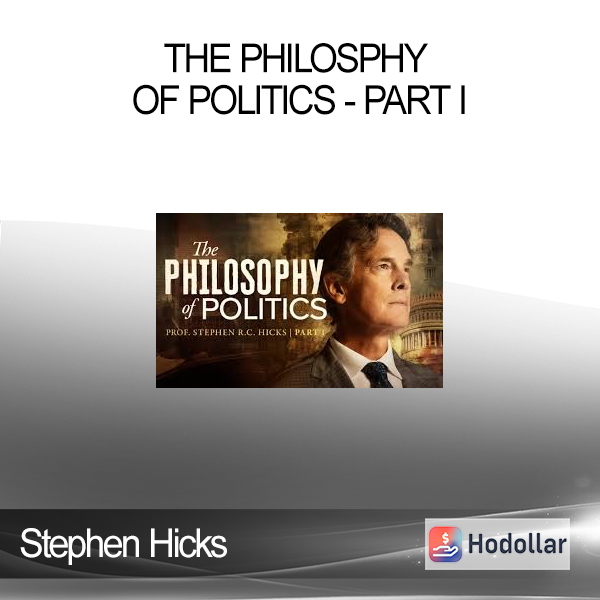
In The Philosophy of Politics Part 1, a nine-hour course, Dr. Stephen Hicks takes us through the development of political philosophy from the late 18th century to the early 20th century, focusing on key thinkers and movements that shaped the modern world.
We examine the conservative response to the French Revolution, the rise of German idealism and Marxism, the defense of liberalism in Victorian England, and the emergence of pragmatism in America.
The course concludes with an analysis of the philosophical foundations of fascism and Nazism and the competing economic theories that arose in response to the Great Depression.
Show less
Study Group
Lectures
1. Revolutionary Danger
In our introductory lecture, Dr. Hicks presents the French Revolution as a cautionary example of how radical political change can go wrong, leading to violence, instability, and collapse.
Together, we consider Edmund Burke’s conservative critique, which argues that meaningful reform must be rooted in tradition and gradual evolution rather than abstract ideals.
The lecture explores Burke’s view that liberty depends on established institutions and inherited wisdom, raising enduring questions about the proper pace and nature of political reform.
2. Hegel and the State
In lecture two, we study the rise of Germany as the leading philosophical nation in the early 19th century, focusing on Georg Hegel’s political philosophy.
We examine Hegel’s rejection of individualism, equality, and democracy in favor of a state-centered philosophy where individuals exist to serve the state, which he views as the manifestation of God’s will on Earth.
Dr. Hicks traces how Hegel’s ideas about the state as an ethical organism, his belief in Germany’s destined role in world history, and his integration of church and state profoundly influenced German political thought for the next two centuries.
3. Engels and Marx
In lecture three, we learn about Friedrich Engels’ visit to industrial England and its impact on the development of Marxist thought.
We examine how the Industrial Revolution brought both economic growth and deep social problems, including poor working conditions and class conflict.
These realities shaped Karl Marx’s materialist critique of capitalism, culminating in his argument that history is driven by class struggle.
Dr. Hicks links these ideas to their broader impact on 20th-century political movements and conflicts, including the Russian Revolution and World War II.
4. Mill on Liberty
In lecture four, Dr. Hicks explores England’s role as a leading Enlightenment nation and the liberal response to rising anti-liberal ideologies in the mid-1800s, focusing on John Stuart Mill.
We trace liberalism’s achievements, including religious tolerance, women’s rights, anti-slavery, rising prosperity, and expanded education, while examining concerns about conformity, nationalism, and socialism.
Mill defends individual freedom as the cornerstone of a healthy society, arguing it should only be limited to prevent harm to others.
5. Pragmatic Democracy
In lecture five, we analyze America’s contribution to political philosophy through pragmatism, focusing on William James and John Dewey.
We explore James’ proposal to redirect warrior instincts toward civilian service and his call for a moral framework based on collective duty.
The lecture concludes with Dewey’s argument that democracy is a dynamic process, where individuals are shaped through education and shared experience, rather than simply protected as isolated rights-bearers.
6. Fascism and Force
In lecture six, we explore the origins and development of fascism, focusing on its emergence in Italy under Benito Mussolini.
We examine how fascism subordinated individual interests to the state, viewing society as an organic whole serving national purposes.
The lecture highlights fascism’s embrace of war, rejection of individualism and pacifism, and its corporatist model of total state control.
7. A Darker Turn
In lecture seven, Dr. Hicks examines the philosophical foundations of Nazi Germany and the ideas that enabled Hitler’s rise.
We explore thinkers like Oswald Spengler and Arthur Moeller van den Bruck, who framed World War I as a conflict between German collectivism and Western liberalism.
The lecture also focuses on Martin Heidegger, whose philosophy promoted national destiny, collective identity, and the rejection of liberalism and communism, illustrating how complex philosophy can justify totalitarianism.
8. Markets and the Middle Path
In our eighth and final lecture, Dr. Hicks examines debates surrounding the Great Depression, focusing on whether its causes lay in unrestrained capitalism or excessive government intervention.
We analyze John Maynard Keynes’ call for a middle path, advocating strategic state involvement to stabilize economies.
The lecture concludes by contrasting Keynesian interventionism with Friedrich Hayek’s defense of free-market capitalism, emphasizing the role of decentralized knowledge and individual planning over central government control.
– After making a purchase, you will see a View your order link to the Downloads page. Here you can download all the files related to your order.
– In case the link is broken for any reason, please contact us and we will resend a new download link.
– If you can’t find the download link, please don’t worry about it. This course is usually available and shipped within one day
– The course you purchased will have lifetime access
– Our support staff is the best by far! Please contact us at email: [email protected] and we will be happy to help!